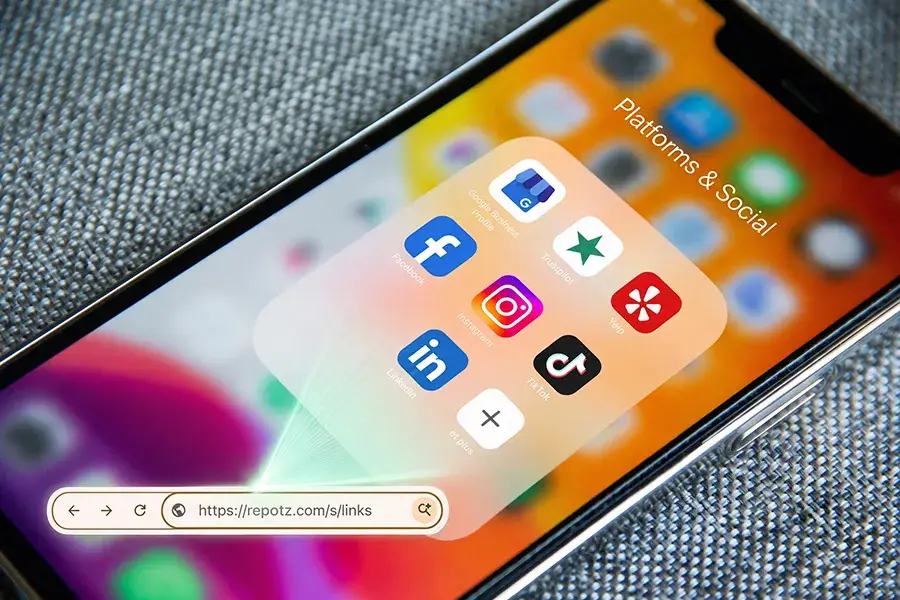
p>A link in bio is often the first thing a customer sees: on your Instagram profile, behind a QR code at the counter, in an email signature. It is also, for most businesses, the least examined page they own.
Most bio pages do exactly one job. Someone taps, the page forwards them somewhere else, and nothing about that moment is kept. That is a router, and a router is a reasonable thing to be. But if the page is the first impression of your business, it can carry more weight than that.
Here are five questions to ask about yours. They work whatever tool you use, and each one is worth something concrete to a local business.
1. Does the page know how the visitor got there?
Someone who scanned a QR code at your counter has just been in your shop. Someone who tapped the link in your Instagram profile has not. They are at different moments and they need different things, but almost every bio page shows them the same list in the same order.
The fix is not personalisation in the surveillance sense. It is reading the context of the visit, which the page already knows: how the visitor arrived, what language their browser asks for, what time it is where they are. A “Lunch menu” link that appears on weekdays between 11 and 2 and steps aside the rest of the week. A review link that moves to the top only after a QR scan, because the person holding the phone just ate your food.
No cookie, no profile, no history. The page reads the request in front of it and orders itself accordingly.
2. What do you keep when the visitor leaves?
A router keeps nothing. The visitor taps through to Google or Instagram, and whatever relationship was possible in that moment belongs to the platform they landed on.
A page that works offers the visitor a way to stay in touch with you, and records that choice properly: an email address given on purpose, with the date the consent was given, in a list you can read and export. In Canada that dated record is not a nicety, it is what makes a later message lawful under anti spam law. Elsewhere it is what makes it welcome.
The test is simple: after a hundred visitors, does your bio page leave you with anything at all?
3. Do your numbers count humans?
This is the question almost nobody asks, and it is the one that changed our own product.
Link pages are heavily crawled. Search engines index them, link previewers fetch them every time the URL is pasted into a group chat, uptime monitors poll them. Each of those fetches can look exactly like a click in a naive counter.
On 2026-08-24 we measured this across the whole RepOtz merchant network, over the complete click history: 54.9% of outbound clicks came from self declared automated agents. Not suspected, not inferred from behaviour: user agents that name themselves as crawlers, previewers or monitors. More than half of what a raw counter would have reported as customer interest was software.
We now exclude that traffic everywhere a merchant sees a number, including their history. Counters across the network dropped by roughly half overnight, and they are finally worth something: a business owner deciding whether to keep printing QR codes for the counter needs to know whether forty people tapped through, or eighteen did while twenty two were bots.
Ask your tool what it counts. If the answer is “clicks”, ask whose.
4. Can you leave with what you built?
The last question is the one that only matters once, and matters completely.
Your links, the contacts who signed up, the record of when each of them consented, the click history: can you export all of it, today, without asking anyone? If the answer is no, the audience on that page is not yours. You are renting it.
This is also why the readable address of the page matters. A page that lives at an address carrying your business name, indexed under your name, with your local business data attached to it, accrues something over time. A page that lives behind a random string does not.
5. Do the links still work?
The quietest failure of a bio page is a link that leads nowhere. A website whose domain was not renewed, a booking page the provider retired, a menu moved to a new address. Nothing on the page changes; it looks exactly as it did the day you built it. The visitor taps, lands on an error, and leaves. Nobody tells you.
No link aggregator we know of checks this. They render a list of addresses and trust that the addresses still mean something. Yet the question is trivial to ask on your behalf: does each link still lead somewhere? Asked weekly, with a real request that follows every redirect the way a phone would, it catches the expired domain and the deleted page before a customer does.
Two things matter in how it is asked. First, patience: a site can be down for an afternoon, so one failed check should never trigger anything; a warning is only worth sending when a link is still down a week after it was first found down. Second, an ending: a link that stays broken for weeks should come off the page, because the page exists for the visitor, and the visitor is better served by one link fewer than by one error more.
How RepOtz answers them
Every RepOtz campaign already has a public link page, at a readable address built from your business name and city. It carries your logo, your colours, your review platforms in the order you choose, your contact links and a downloadable business card. That part is not new.
What we shipped this month is the rest of the list above:
- Display rules per link. Show, hide or pin a link based on how the visitor arrived, their language, or a day and time window. Conditions combine, and none of them reads anything about the person.
- Audience capture. An optional block at the bottom of the page: email address, and a first name and phone if the visitor wants to give them. Every sign up joins your contacts with a timestamped consent, viewable and exportable as CSV. Available on every plan, because an audience you cannot take with you is not an audience.
- Honest measurement. Page views, clicks per link, and a click through rate, with robot traffic excluded from all of it.
- Monitored links. Every link on the page is checked every week. A link still offline a week after it was first found down earns you an email, a final reminder comes a week later, and after three weeks without a fix the link is removed from the page. Fix it and switch it back on, and it reappears at once. A passing outage triggers nothing.
Sending review requests to those contacts, and setting display rules, are Pro plan features. Collecting the audience, reading it and exporting it are not: those are yours whatever you pay.
If you want the head to head against a pure link aggregator, we wrote that comparison separately in why a simple link aggregator cannot manage your reputation. This post is about the capability, not the matchup. The full offer is described on the link in bio page, and the discipline behind it on reputation optimization.
Frequently asked questions
Do I need a website to use a link in bio page?
No. The page stands on its own: your brand, your links, your downloadable business card, your local search presence. If you do have a website, it simply becomes one more link on the page.
Do display rules track visitors?
No. They read only the context of the current visit: how the visitor arrived, their browser language, their local time. No cookie is set, no profile is built, nothing carries over from one visit to the next.
Why did my click numbers drop?
If you are a RepOtz merchant and your counters fell this month, you did not lose visitors. Robot traffic is now excluded from every figure, including your history. The new numbers are the ones you can plan with.
Can I take my contacts with me?
Yes. Contacts export to CSV from your dashboard, with the consent date and the origin of each one. That file doubles as your consent register.
What happens when one of my links stops working?
RepOtz checks it again a week later. If it is still down, you get an email naming the link and the reason, then one final reminder a week after that. If nothing changes after three weeks, the link is taken off your page so visitors stop landing on an error. Correct the address and reactivate the link, and it is back immediately. The only active link of a business is never removed automatically.
The short version
A link in bio that routes is not broken, it is just idle. Ask your page whether it reads context, keeps an audience, counts humans, checks its own links, and lets you leave. Five answers, and you will know whether the first thing your customers see is working for you.
Ready to optimize your reputation?
Get a free audit of your online presence in seconds.