How Afrotech Canada ran a summit day on one QR code
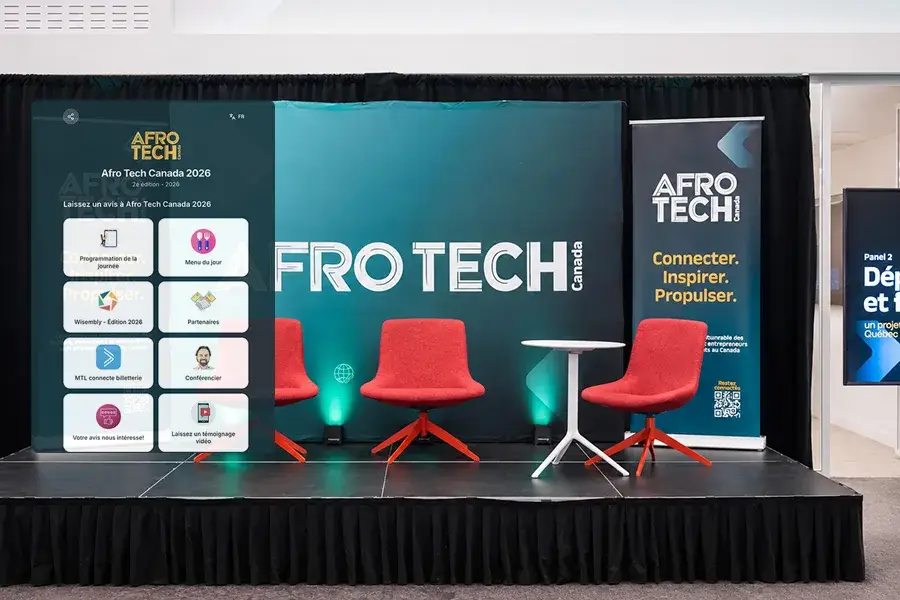
Every conference organiser knows the moment: the programme goes to the printer on Monday, a speaker cancels on Wednesday, and on the day itself four hundred sheets of paper are wrong.
Afrotech Canada, an annual technology summit in Montreal, ran its 2026 edition differently. One QR code carried the day: the schedule, the menu, the speaker page, the live question and answer platform, the partner offers, and the form where attendees said what they thought of it.
Here is how they got there, what attendees actually opened on the day, and what came back.
First, one address for the whole year
The summit started using RepOtz in January 2026, five months before the event, and not for the event itself. It needed the ordinary thing every organisation needs: one link that carries everything a visitor might want, from wherever it is posted.
Behind that link: the ticketing page, Instagram, the website, LinkedIn, Facebook. Between 11 January and 29 June it was opened 162 times, and the ticketing page was its most used destination. Nothing spectacular, and that is the point: it is the piece that was already in place when the day of the summit arrived.
Then, a second code built for one day
A month before the summit, the organisers created a separate code, named in their account for exactly what it was: the day of planning code.
It carried what people ask for during an event, in the order they ask for it: the programme as a PDF, the menu, the speaker page, the live Q and A platform, the partners page, and the feedback form. Alongside them, offers from the ecosystem: a partner ticketing page, an incubator information session, an entrepreneurship workshop, a partner book launch.
All of it behind one address, printed once. When something changed, the organisers changed the destination, not the paper. That is the whole argument for doing it this way, and it costs nothing to test at your next event.
What attendees opened on 12 June
On the day of the summit, the code was opened 44 times between 8am and 9pm, with the busiest hour at 3pm. What they opened, in order:
- The programme, 117 times. The single most opened destination of the day, which is exactly what a printed sheet would have been used for.
- The menu, 28 times.
- The speaker page, 35 times, and the live Q and A, 14 times.
- The partner ticketing page, 22 times, and the feedback form 33 times.
And the feedback, asked for on the spot
The same code carried a feedback form: a star rating, then a comment. Over the period, it was opened 119 times, and one attendee completed it, at 9.25pm on the day of the summit, once the room had emptied: five out of five, with a written comment.
One. We could have left that number out, or replaced it with a percentage that sounds larger. It is more useful stated plainly, because it carries the actual lesson of this case: at an event, the ask has to happen while people are still in the room. Nineteen people opened the form, one filled it in after the doors closed. An organiser who wants more has to make the request part of the programme, from the stage or on the table, at the moment the session ends, rather than leaving it as one destination among twelve.
What that one form did produce is something a printed comment card does not: a rating, a comment and a way to answer the person who wrote it, sitting in the organisers’ account rather than in a box of paper slips nobody transcribes.
The part that surprised us: the link kept working
An event ends. Its QR code usually dies with it, on a badge in a drawer.
This one did not. In the weeks after the summit, the same code was still being opened, and the organisers were still adding destinations to it: an incubator information session scheduled for September, a partner workshop, a book launch. The code printed for one day in June became the ecosystem’s noticeboard for the rest of the season, without a single reprint.
Across both codes, from 11 January to 29 June 2026, the summit collected hundreds openings. That count excludes automated traffic: on this account, roughly two out of three raw clicks came from search engine crawlers and AI bots, and publishing those would have tripled the figure while proving nothing.
What this does not prove
These are modest numbers, and we are not going to inflate them. 44 openings on the day is not a crowd, it is the fraction of attendees who reached for their phone rather than asking a neighbour. We cannot tell you how many people attended, how many read the programme over someone’s shoulder, or whether anyone bought a ticket because of the code.
What is measurable: the programme was the most opened destination of the day, the organisers changed what the code pointed to without reprinting anything, and the link outlived the event it was made for.
What another organiser can take from this
Four things.
Print the address, not the content. Anything printed is frozen at the moment it goes to the printer. A code that resolves to a page you control can be corrected on the morning of the event, from a phone, in the room.
Put the boring things first. The programme and the menu were opened more than everything else combined. Attendees do not scan to discover your brand, they scan because they want to know what is happening at 3pm and what is for lunch.
Ask for the feedback in the room, not in the list. A feedback form sitting as one destination among twelve gets opened and abandoned. Ask from the stage at the end of a session, while the impression is fresh and the phone is already out. One completed form out of nineteen openings is the cost of asking passively.
Do not let the code die with the event. The audience you gathered is reachable for weeks afterwards through the same address. That is the cheapest channel an organiser will ever have, and most throw it away the following morning.
If you want to know how your own organisation looks to Google and to AI assistants before your next event, our free reputation audit scores six pillars out of 100. The method behind it is the RepOtz Framework™.
Ready to optimize your reputation?
Get a free audit of your online presence in seconds.