Every organisation with one website and several channels ends up with the same small problem: the bio of its Instagram or LinkedIn page holds one link, and it has seven things to point to.
The usual answer is a third-party bio page. It works, and it sends every visitor to somebody else’s address. Réseau IC2, a network of Cameroonian-born engineering professionals in Canada, chose the other route: its link page lives inside its own website, at reseauic2.org/link-in-bio, and nothing on it says RepOtz.
Here is what the network built, how one script tag put it on its own site, and what an embedded page can and cannot do.
One page for everything the network does
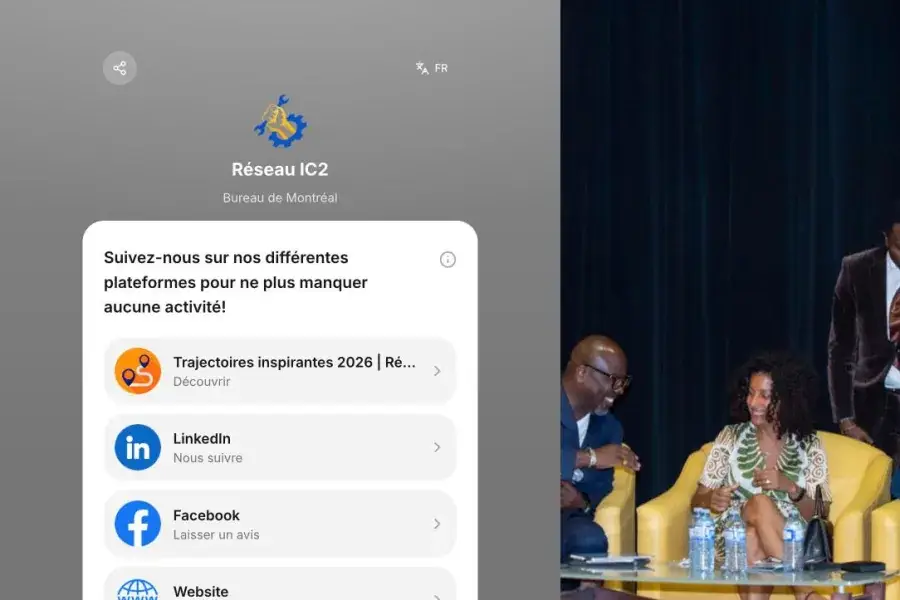
Réseau IC2 brings together engineering professionals of Cameroonian origin across Canada: networking, mentoring, job referrals, training. Its audience is spread over several channels, and the page it built with RepOtz carries all of them in one place:
- The booking page of its next event first. “Trajectoires inspirantes 2026” sits at the top of the list, with a “Réserver ici” label written by the organisers. When the next event comes, they replace the tile; the address stays.
- Its LinkedIn and Facebook pages, where the community follows the network’s news.
- Its website, for the programmes, the team and the news.
- Three ways to reach a person: Messenger, an email address and a WhatsApp line, kept behind a “see all” link so the page opens on the four things most visitors want.
Above the list, one sentence the organisers wrote themselves, in French, English and Spanish: follow us on our platforms so you never miss an activity. Below it, a button saves the network’s contact card to the visitor’s phone, so a person met at an event keeps the network’s coordinates without typing anything. The page carries the network’s logo and a photograph of one of its events as its cover.
All of that is a standard RepOtz platforms page. What is different is where it is displayed.
One script tag on a WordPress page
The network first used its page at its RepOtz address, as every customer does. Then it created an empty page on its own WordPress site, reseauic2.org/link-in-bio, and pasted one line into an HTML block:
<script src="https://api.repotz.com/embed/emb_....js" async></script>
That is the whole integration. The script checks that it is running on an authorised site (the organisers list the domains allowed to display their page), then draws the RepOtz page inside a frame that fills the browser window. On the network’s site, the frame looks like the page itself: the address bar reads reseauic2.org, the cover photo and the link tiles fill the screen, and the “RepOtz” line that appears at the bottom of every page hosted on repotz.com is simply not there. Sharing the page shares reseauic2.org/link-in-bio, not a RepOtz address. The contact card, the language switch and the links all work as they would anywhere else.
When the organisers change a destination, add the next event or rewrite the title, they do it in their RepOtz account. The WordPress page never changes; it still contains one line.
Where the page lives, and why it matters
A bio page is often the first thing a new contact opens after meeting an organisation. For a network whose purpose is to bring people in, that first page is a front door, and Réseau IC2 wanted the door on its own house.
Keeping the page on reseauic2.org does three things a third-party bio page cannot. It keeps the network’s name in the address bar, on the one page most likely to be shared. It lets the network write around the page: the WordPress page can carry its own title, introduction and navigation, in the site’s own design, with the link page as one block of it. And it gives the network one address to print, post and share for years, whatever tool sits behind it.
What an embedded page is, and is not
It is worth being precise, because “white label” is a phrase that promises more than it should.
What the visitor gets is the organisation’s page. Their domain in the address bar, their photo, their title, no third-party branding, a share button that shares their address. For the person on the phone, that is the entire experience, and it is what most organisations mean when they ask for white label.
What the visitor does not see is a frame. The page is drawn by RepOtz inside a window on the organisation’s site. Two consequences follow. First, the text of the link page is not part of reseauic2.org as far as search engines are concerned: what Google reads on that URL is the WordPress page, which contains one line of script. If the organisation wants that page to rank for something, it has to write the words on the WordPress page itself, around the frame. Second, the frame depends on RepOtz being up; if it were not, the page would show an empty space rather than an error, by design, but an empty space all the same.
Neither point is a reason not to do it. They are the terms of the deal, and an organisation should know them before pasting the line.
What we had to fix to get there
Honesty also applies to us. When the network first published the page, the frame stopped at the height of the content and left a white band under it. Making the frame fill the window was an option the organisers had to know about; almost nobody does, so we made it the default. A second fault appeared once that was fixed: the page inside the frame still hugged its content, because one parameter was lost on the way. A third stayed invisible to us and visible to the organisers: their browser had memorised the old behaviour and kept showing it after the fix was live. All three were corrected the same day, and they are the reason the default now works without anyone reading a manual.
What another organisation can take from this
Keep your visitors on your domain. A bio page is often the first thing a new contact opens. Sending them to a third-party address hands over the one thing you already own.
Put the next event first. The tile people are most likely to need should be the first they see; everything else can wait behind a “see all”.
Edit in one place. The event tile changes with each edition without anyone opening WordPress. The page you print, post and share should not need a developer each time your programme does.
Give people a way to keep you. A contact card saved in one tap outlives a scrolled-past post.
Know what a frame does not do. It shows your page; it does not write your website’s text for you. Put the words that matter on the page around it.
Disclosure: a member of the RepOtz team is a member of Réseau IC2. The network’s account was set up as any other customer’s, on the selected plan.
If you run a page like this and want to know how your organisation looks to Google and to AI assistants, our free reputation audit scores six pillars out of 100. For the questions to ask any link page before trusting it, see five questions that show whether your link in bio does anything else.
Ready to optimize your reputation?
Get a free audit of your online presence in seconds.