How Marché Dakar built its reputation from day one
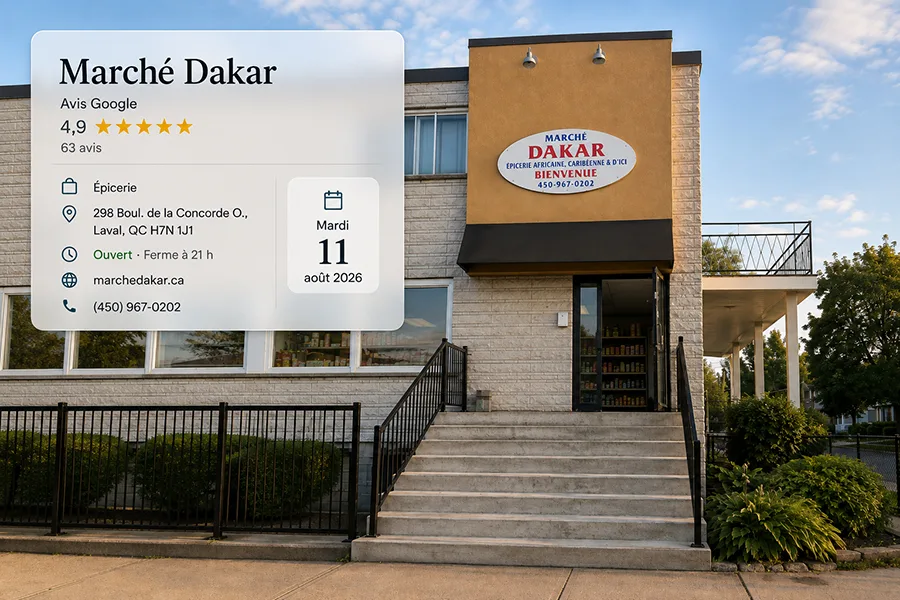
Marché Dakar opened in Laval to bring African and Caribbean products back within reach of the community that grew up on them. Like every new store, it faced the same starting problem: the people who would love it did not know it existed yet.
Most local businesses answer that problem with the storefront, the shelves and the word of mouth of the first customers. Marché Dakar did that too, and added something almost no new business does: it started collecting the proof of those first customer experiences in its first weeks, instead of waiting for a bad review to make reputation urgent.
This is what that decision produced over twelve months, measured from the store’s own account.
The starting point: a real store, an empty digital trace
A specialised grocery store lives on trust. Someone looking for plantain, attiéké or a specific brand of palm oil in Laval searches on Google, opens Maps, or increasingly asks an AI assistant where to go. Before they ever push the door, they are reading signals: reviews, ratings, photos, an address that resolves, a phone number that works.
In its first weeks, Marché Dakar had the store and the customers. What it did not have was any of that trail online. Every satisfied customer walked out and the experience disappeared with them.
On 11 August 2026, the store’s Google profile carries 63 reviews for a 4.9 average. That is the destination. What follows is the road, and what we can and cannot prove about it.
What was set up, and where
One QR code at the checkout counter, on a small stand, where the customer is already stopped and already holding their phone. It opens a two step journey: how did it go, then where would you like to say it.
A customer who taps the happy face lands on the store’s destinations: its Google review form first, then Instagram, WhatsApp, Facebook, TikTok, the website and driving directions. Eight destinations in total, the store’s own choice, none imposed. A customer who taps the unhappy face reaches the store privately, and also keeps the public option: nothing is filtered, nothing is gated, which is both the law and the rule of every review platform.
That is the whole setup. No campaign, no incentive, no request written on a receipt.
What twelve months produced
Measured on the store’s account from 4 July 2025 to 29 June 2026:
- 151 customers used the counter journey, 150 of them from a phone in the store.
- 150 of those 151 were positive, and the single dissatisfied customer chose to write to the store privately, with the public review option still offered on the same page.
- 299 journeys continued to a destination, once automated traffic is removed.
- 101 of those went to the Google review form. This is the number of customers we handed to Google with the form already open. It is not the number of reviews written: what happens on Google’s side is not visible to us, and any tool that tells you otherwise is guessing.
- The rest spread across the store’s other destinations: Instagram, WhatsApp, Facebook, the website, TikTok and directions.
One honest note on those numbers. Raw click counts on any public page include search engine crawlers and AI bots, which follow links exactly as a customer would. Over this period, roughly half of the raw clicks on this account came from declared bots. Every figure above excludes them. We would rather publish a smaller number that means something than a bigger one that means nothing.
What we are not claiming
We cannot tell you that Marché Dakar sold more because of this, and we will not pretend otherwise. Nobody can isolate a QR code from a good location, a good product and a community that talks.
We also cannot tell you which of those 63 Google reviews came from the counter. Google does not tell anyone where a review came from, and it would be easy, and wrong, to put the two numbers side by side and let you draw the line. What can be said is narrower and verifiable: the store had no organised way of asking before, 101 customers were handed the review form with it already open, and the profile that stood empty now carries 63 reviews at 4.9.
What is measurable is this: 151 customer experiences that would have left no trace now exist as a signal, one dissatisfied customer chose to tell the store directly rather than post publicly, and a store that opened with no online reputation no longer starts every search from zero.
Why the store is named and no one is quoted
Marché Dakar agreed to have its name, its results and its numbers published. Its management asked not to be quoted or named personally, and we consider that entirely reasonable: the store’s decision to open with a review journey at the counter, and what that produced, is the story. It does not need a face.
Everything above can be checked without us. The store is at 298 boulevard de la Concorde Ouest in Laval, its website and its Google profile are public, and the figures come from its own RepOtz account over a stated period, with the way automated traffic is excluded spelled out.
What another local business can take from this
Three things, and none of them require a budget.
Start before you need it. Reputation is the one asset that cannot be bought back later. The customers you serve this month are writing it whether you capture them or not.
Ask where the customer already is. The counter works because the customer is stopped, satisfied and holding their phone. An email sent three days later competes with everything else in the inbox.
Give the unhappy customer a private door, and keep the public one open. One dissatisfied customer in twelve months reached the store directly. That is not filtering, which is forbidden and detectable: both paths stay available to everyone. It is simply making the private path easy to find.
If you want to know where your own reputation stands before changing anything, our free reputation audit scores six pillars out of 100 and tells you which one is costing you the most. The method behind it is the RepOtz Framework™, and the wider discipline is what we call reputation optimization.
Ready to optimize your reputation?
Get a free audit of your online presence in seconds.